
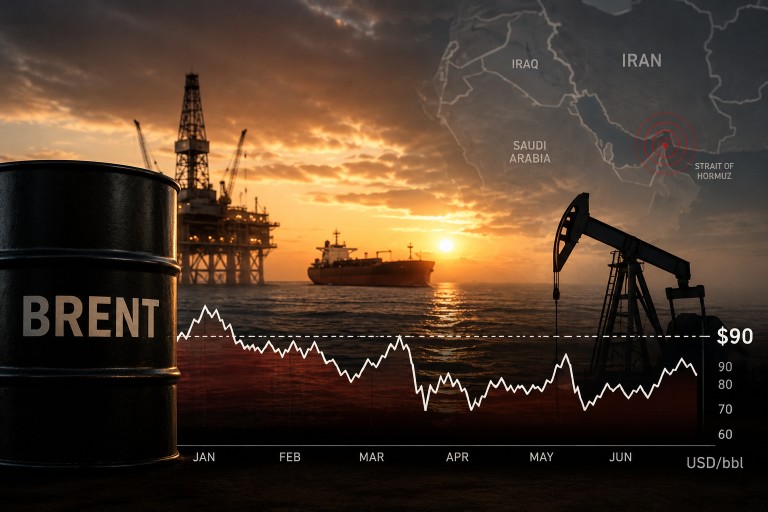
Despite an impressive weekly surge in prices, Brent crude may need a more extended disruption in the Strait of Hormuz or clearer indications of tightening global supplies to surpass the $90 per barrel threshold. Closing the week near $85, the global oil benchmark recorded an 11% increase, marking its most significant weekly gain since April, while the U.S. benchmark, West Texas Intermediate, edged closer to $80. The uptick in oil prices follows renewed military tensions between the United States and Iran, which have disrupted key Middle Eastern supply routes and slowed tanker movements through the Strait of Hormuz—a critical passage handling about 20% of the world’s oil flows.
Despite the escalation in conflict and significant slowdown in Hormuz tanker traffic, Brent crude has struggled to break past this week’s high of $87.55 per barrel. Analysts suggest that the market’s belief in the potential for diplomatic resolutions is tempering further price hikes. Investors are keenly observing whether global oil inventories start to decrease sharply and if the disruptions in the Strait of Hormuz persist for a longer period.
In the face of increasing military exchanges, oil markets have shown a surprising resilience. Brent crude has been trading within a confined range recently, indicating that investors might be expecting the tensions to de-escalate rather than intensify further. Nonetheless, the Strait of Hormuz remains a significant area of concern for global energy markets. With tanker traffic slowing, exporters are exploring alternative routes to lessen reliance on this strategically vital waterway.
The repercussions of the situation extend beyond crude oil, affecting refining margins in the United States, where there is a tightening of diesel and gasoline supplies. Similarly, fuel markets in Europe are beginning to strain under the pressure. The situation is exacerbated by a reduction in Russian fuel exports, adding to the global energy supply challenges.
Market watchers are now focused on two critical developments: the potential for a significant drop in oil inventories, signaling a supply shortfall, and the outcome of diplomatic efforts. A failure in negotiations could lead to a prolonged disruption in the Gulf. Until one of these scenarios unfolds, experts anticipate that Brent crude is unlikely to exceed the $90-per-barrel mark, despite the ongoing geopolitical risks.