
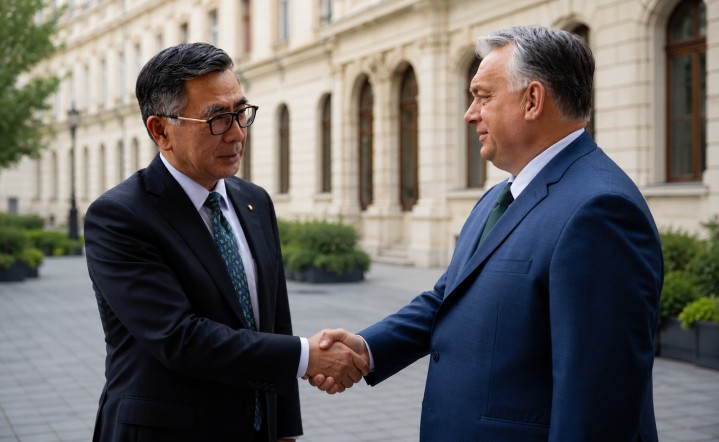
Toshihiro Suzuki, the President of Suzuki Motor Corporation, made a notable visit to Budapest on Thursday, engaging in separate discussions with Hungarian leaders, including Prime Minister Viktor Orbán and Prime Minister Péter Magyar. The visit underscored Suzuki’s enduring connection with Hungary, where the company has been a significant player since the early 1990s.
In a meeting with Prime Minister Orbán, the conversation revolved around the current state of the global economy and the automotive industry’s evolving landscape, which is increasingly influenced by the advent of electric vehicles and new technologies. These discussions highlight the challenges and opportunities that lie ahead for both Suzuki and Hungary in adapting to these global shifts.
Suzuki’s involvement in Hungary dates back to the establishment of its subsidiary in 1991, with the Esztergom manufacturing plant commencing vehicle production a year later in 1992. This plant has grown to be a cornerstone of Hungary’s automotive sector, providing substantial employment and significantly contributing to the nation’s export economy. Suzuki’s commitment to Hungary has helped solidify its status as a key player in the region’s industrial landscape.
After his meeting with Orbán, Toshihiro Suzuki also held talks with Prime Minister Péter Magyar. Their discussions focused on potential investment projects and future developments within Hungary. They also addressed the broader challenges faced by the automotive industry, particularly the shift towards electric mobility. Magyar praised Suzuki for its reliable partnership over the past thirty years, recognizing the company’s role as a dependable foreign investor in Hungary.
The visit by Suzuki’s president not only reinforced the company’s commitment to Hungary but also highlighted the ongoing collaborative efforts to navigate the transformative changes in the automotive industry. As the sector continues to pivot towards electric vehicles and innovative technologies, the strong ties between Suzuki and Hungary are poised to play a pivotal role in shaping the future of automotive manufacturing in the region.